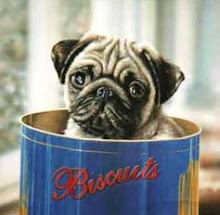
Pugs are about the most unique looking breed of dogs you will come across. It's pretty hard to mistake a purebred Pug or even a Pug mix for anything else. Pugs are basically miniature Mastiffs with Pekingese faces. They average about seventeen pounds and are built a lot like furry bricks with legs and extremely curly tails. They average about ten or eleven inches in height at the highest point of their shoulders (called the withers).
Pugs come in a few colors, but two are the most recognized. One is solid black, and the other is fawn with an all-black face. The rarest acceptable color is called silver, which is a light grey body and a black mask. In the history of the Pug, many other colors popped up, but these are the only three colors now accepted by the American Kennel Club (AKC). Many black pet Pugs have small white patches on them.
The adorable Pug pushed-in face is the subject of much controversy among dog lovers. It is argued that the current construction of the nose and mouth makes for a very unhealthy dog with a lot of breathing problems. Pet Pugs sometimes have longer noses than the breed standard calls for. However, until the breed standard is changed, all Pugs with nearly flat faces are considered the ideal Pug head.
Pugs have very broad skulls, button noses, huge black eyes and small, thin, velvety semi-floppy ears. Their heads are to be round, not apple shaped. Their faces are very wrinkly, like a Mastiff's (only smaller and flatter). A lot of wrinkles are encouraged in the Pug breed standard. The coat is short, smooth and fairly glossy. The body should be Bulldog like, shaped round and broad and the legs are short and even. The tail is a curly-cue resting on the back.
Pugs come in three colors, but odds are you'll only see two in your lifetime. The one color is all black and the other is an apricot or fawn with a black face. The third color is silver (a light grey), which is considered very rare. In the Pug's history, there were many other colors, and sometimes they crop up in future generations. They would not be allowed as show Pugs.
Most Pugs have temperaments as distinctive as their appearance. Since they were bred to be companion animals, they do their utmost to get along with everyone, no matter what their species. This good temperament is also part of their breed standard. They are charming, ready for fun, thrive on being adored and levelheaded. Their eyes are literally and metaphorically bright and full of life. Pet Pugs often have dewclaws and straighter tails than their tightly curled show brothers. No matter what they look like, Pugs make great pets.
Owning one Pug may lead to owning a couple of Pugs because they are such wonderful pets. If people knew basic Pug information before they bring a puppy home there would be a lot fewer abandoned Pugs.
Showing posts with label pug. Show all posts
Showing posts with label pug. Show all posts
Thursday, April 24, 2008

Thursday, April 17, 2008
Looking For Pugs
Pug dogs are an excellent breed of dog and many choose to add more than one to their household. However, as with all dog breeds, the Pug isn't for everyone and every household. Therefore, it is best to consider the negative aspects of the breed before determining if they are the right dogs for you and your household. By properly selecting a breed that will work with you then you can make sure you have a positive experience. By doing your research and considering the negative aspects of a Pug dogs you will be able to determine if the personality and lifestyle of a put will fit with you and your household. So carefully and seriously consider the nature and characteristics of Pug dogs before you make the decision to add one to your household. The three most difficult areas include health issues, shedding and housetraining. Each will be discussed in more detail next.
When it comes to health, Pug dogs are likely to get many genetic health issues. As a result the Pug dog will require more veterinary care than the average breed of dog. While this won't happen with all Pugs, you should be prepared to spend a lot of time and money at the vet's office. So if you don't want to make this twelve plus year commitment then you may want to consider another breed.
Another common issue is shedding. Despite their short hair, the Pug sheds more than other breeds. So if you don't want to deal with dog fur all over your house, car and clothes then Pug dogs may not be right for you. Nothing you do can help you keep down the amount of shedding a Pug has, you will simple find dog hair all over the place. You can keep the hair down by cleaning, but it would have to be done regularly.
Housetraining is the last issue you will want to consider with Pug dogs. The Pug isn't the easiest of breeds to train. Their small size makes them more difficult to train than larger breeds, which have a greater capacity to hold. But size isn't the only obstacle owners face, as there is also the issue of the Pug dog's stubborn nature at times, which make them less cooperative to train than other breeds. Training of Pug dogs can happen within three months of adding the dog to your household if you have owned Pug dogs before or if you have a skilled training system in place from owning previous dogs. However, for most people you should expect to spend at least a year or more to teach your Pug proper housetraining techniques. So, if dealing with a puppy that isn't housetrained for a few years it may not be a good idea to get a Pug.
It is important to caring consider the pros and cons of owning a Pug. You can determine if they are right for you by researching Pug information.
When it comes to health, Pug dogs are likely to get many genetic health issues. As a result the Pug dog will require more veterinary care than the average breed of dog. While this won't happen with all Pugs, you should be prepared to spend a lot of time and money at the vet's office. So if you don't want to make this twelve plus year commitment then you may want to consider another breed.
Another common issue is shedding. Despite their short hair, the Pug sheds more than other breeds. So if you don't want to deal with dog fur all over your house, car and clothes then Pug dogs may not be right for you. Nothing you do can help you keep down the amount of shedding a Pug has, you will simple find dog hair all over the place. You can keep the hair down by cleaning, but it would have to be done regularly.
Housetraining is the last issue you will want to consider with Pug dogs. The Pug isn't the easiest of breeds to train. Their small size makes them more difficult to train than larger breeds, which have a greater capacity to hold. But size isn't the only obstacle owners face, as there is also the issue of the Pug dog's stubborn nature at times, which make them less cooperative to train than other breeds. Training of Pug dogs can happen within three months of adding the dog to your household if you have owned Pug dogs before or if you have a skilled training system in place from owning previous dogs. However, for most people you should expect to spend at least a year or more to teach your Pug proper housetraining techniques. So, if dealing with a puppy that isn't housetrained for a few years it may not be a good idea to get a Pug.
It is important to caring consider the pros and cons of owning a Pug. You can determine if they are right for you by researching Pug information.
Thursday, April 10, 2008
What To Expect When You Have A Pug
Pugs are terrific dogs with a lot of personality. They are a toy breed, with a medium-small body, weighing in from thirteen to twenty pounds and are twelve to fourteen inches tall. They have a wrinkly face and big dark eyes that light up with they are excited. They have a lot of expression in their eyes. They are often companion dogs, but they have also been used as coach dogs, guard dogs and to accompany monks.
The term Pug has likely been derived from the Old English word of Pugg, which is an affectionate term for a playful little devil or monkey. That name fits this dog, as it is very playful. It is very popular because of its personality, having originated in China, also showing up in Japan and other countries and eventually to England, where it later came to the United States. The American Kennel Club officially recognized the breed in 1885. The Pug Dog Club of America was founded in 1931, and it has been growing in popularity ever since. He isn’t considered common, but is also isn’t rare. It is a favorite breed around the world.
Pugs truly love their owners, and are one of the most loyal dogs. They want a lot of attention from their owners, and tend to get jealous of they don’t get enough. They also can be anxious or agitated if they are ignored. They also love other dogs and pets, and children, as they are such social dogs. They don’t like it if their owner uses harsh punishment, as they are sensitive to the tone of their owner’s voice. They like to make their owners laugh, and they are usually found right with their owner, in their lap or at their feet.
The Pug breed is energetic, particularly in the early years. While they have a lot of energy, they are often a bit more difficult to train, as they don’t have a lot of patience for the repetitive training sessions required to be trained.
Pugs love to go for walks, but are somewhat limited as they are very sensitive to extremes of temperature and have some trouble breathing when they exercise.
A Pug dog can be a wonderful family pet. It will be loyal and playful, and love the attention that children are willing to give a smaller, energetic dog. It is very eager to please, and it will often entertain whoever will give it attention. They love to go for walks with their humans.
While it isn’t the easiest to take to training it has many other terrific qualities, like its playfulness and clownish behavior. They are terrific companion dogs, which get along well with all human and animal pets, making it a natural addition to a family.
If you are considering getting a Pug for your family, you should check with local breeders who sell them healthy and with good breeding. If you buy your Pug as a puppy, it will be cute and little, with the adorable wrinkles already in its face. Bought so young, you will be its human, and it will be your loyal companion for a lifetime.
The Pug is a breed of dog well-known for being playful, smart and extremely devoted to their owner. This article will give you Pug information about the breed, specifically the personality that a Pug tends to have.
The term Pug has likely been derived from the Old English word of Pugg, which is an affectionate term for a playful little devil or monkey. That name fits this dog, as it is very playful. It is very popular because of its personality, having originated in China, also showing up in Japan and other countries and eventually to England, where it later came to the United States. The American Kennel Club officially recognized the breed in 1885. The Pug Dog Club of America was founded in 1931, and it has been growing in popularity ever since. He isn’t considered common, but is also isn’t rare. It is a favorite breed around the world.
Pugs truly love their owners, and are one of the most loyal dogs. They want a lot of attention from their owners, and tend to get jealous of they don’t get enough. They also can be anxious or agitated if they are ignored. They also love other dogs and pets, and children, as they are such social dogs. They don’t like it if their owner uses harsh punishment, as they are sensitive to the tone of their owner’s voice. They like to make their owners laugh, and they are usually found right with their owner, in their lap or at their feet.
The Pug breed is energetic, particularly in the early years. While they have a lot of energy, they are often a bit more difficult to train, as they don’t have a lot of patience for the repetitive training sessions required to be trained.
Pugs love to go for walks, but are somewhat limited as they are very sensitive to extremes of temperature and have some trouble breathing when they exercise.
A Pug dog can be a wonderful family pet. It will be loyal and playful, and love the attention that children are willing to give a smaller, energetic dog. It is very eager to please, and it will often entertain whoever will give it attention. They love to go for walks with their humans.
While it isn’t the easiest to take to training it has many other terrific qualities, like its playfulness and clownish behavior. They are terrific companion dogs, which get along well with all human and animal pets, making it a natural addition to a family.
If you are considering getting a Pug for your family, you should check with local breeders who sell them healthy and with good breeding. If you buy your Pug as a puppy, it will be cute and little, with the adorable wrinkles already in its face. Bought so young, you will be its human, and it will be your loyal companion for a lifetime.
The Pug is a breed of dog well-known for being playful, smart and extremely devoted to their owner. This article will give you Pug information about the breed, specifically the personality that a Pug tends to have.
Wednesday, March 5, 2008
Pug FAQ: What Was The History Of Pug?
There are a lot of arguments in many Pug information sources as to where the Pug originated and what breeds went into making such a distinctive looking dog. All the sources agree the dog has Asian roots, although not all of the experts are convinced that China was their home country. However, snub-nosed golden dogs were recorded in the days of Confucius, about 700 BCE. A more detailed report is found of Chinese dogs that very much resembled Pugs in 400 BCE.
Pugs were bred to be the companions and protectors of royalty. Although the Pug was to go through many changes physically, the basic temperament seems to have been the same. Pugs have always been noted for their abilities as a watchdog, for their even temperament, and their devotion to their people. Fortunately, these qualities have not been bred out, although some physical features, like a longhaired coat, have.
Small snub-nosed dogs in China were considered Imperial property. Chinese Emperor Ling To (168 – 190 CE) is reported to have any Pug-nappers be put to death. However, his Pugs had Imperial guards around them, so they were most likely safe. Back then it is thought Pugs came in both long and short coats, again suggesting a Pekingese influence. Pugs were also seen in many colors, not just the three colors recognized today (fawn, black and silver).
Pugs were seen and highly coveted by the first European explorers and traders with China. Gradually, they became the dog of the Royal courts of Europe. One of the most notable Pug owners was Dutch King William the Silent of the House of Oranges. His pet Pug was a masterful watchdog and warned his royal master in time to escape an assassin. The Pug then became the official dog of the House of Orange.
Other Pug owners of note throughout history include Josephine, the infamous wife of Napoleon and the English painter William Hogarth, who included his Pug "Trump" in several paintings. If Hogarth was accurate, then Pugs in the sixteenth century had much longer legs, leaner frames and slightly longer noses than they do today. Since there was not a large gene pool of Pugs in Europe, it is thought that for centuries they were crossed with Bulldogs and possibly small Mastiffs.
The Pug as we know today came about in the 1800's, when the first organized dog shows began in Europe. It didn't take long for the idea of dog shows to cross the Atlantic. The American Kennel Club (AKC) officially recognized the breed in 1885. The AKC, incidentally, was founded in 1884. Pugs have been consistently one of the top twenty most registered dog breeds in America for decades. Their plan to take over the world is nearly complete.
Pug history can be found on the Internet and at your local library. If everyone who wanted a Pug puppy knew basic Pug information first,.there would be fewer abandoned Pugs.
Pugs were bred to be the companions and protectors of royalty. Although the Pug was to go through many changes physically, the basic temperament seems to have been the same. Pugs have always been noted for their abilities as a watchdog, for their even temperament, and their devotion to their people. Fortunately, these qualities have not been bred out, although some physical features, like a longhaired coat, have.
Small snub-nosed dogs in China were considered Imperial property. Chinese Emperor Ling To (168 – 190 CE) is reported to have any Pug-nappers be put to death. However, his Pugs had Imperial guards around them, so they were most likely safe. Back then it is thought Pugs came in both long and short coats, again suggesting a Pekingese influence. Pugs were also seen in many colors, not just the three colors recognized today (fawn, black and silver).
Pugs were seen and highly coveted by the first European explorers and traders with China. Gradually, they became the dog of the Royal courts of Europe. One of the most notable Pug owners was Dutch King William the Silent of the House of Oranges. His pet Pug was a masterful watchdog and warned his royal master in time to escape an assassin. The Pug then became the official dog of the House of Orange.
Other Pug owners of note throughout history include Josephine, the infamous wife of Napoleon and the English painter William Hogarth, who included his Pug "Trump" in several paintings. If Hogarth was accurate, then Pugs in the sixteenth century had much longer legs, leaner frames and slightly longer noses than they do today. Since there was not a large gene pool of Pugs in Europe, it is thought that for centuries they were crossed with Bulldogs and possibly small Mastiffs.
The Pug as we know today came about in the 1800's, when the first organized dog shows began in Europe. It didn't take long for the idea of dog shows to cross the Atlantic. The American Kennel Club (AKC) officially recognized the breed in 1885. The AKC, incidentally, was founded in 1884. Pugs have been consistently one of the top twenty most registered dog breeds in America for decades. Their plan to take over the world is nearly complete.
Pug history can be found on the Internet and at your local library. If everyone who wanted a Pug puppy knew basic Pug information first,.there would be fewer abandoned Pugs.
Subscribe to:
Posts (Atom)